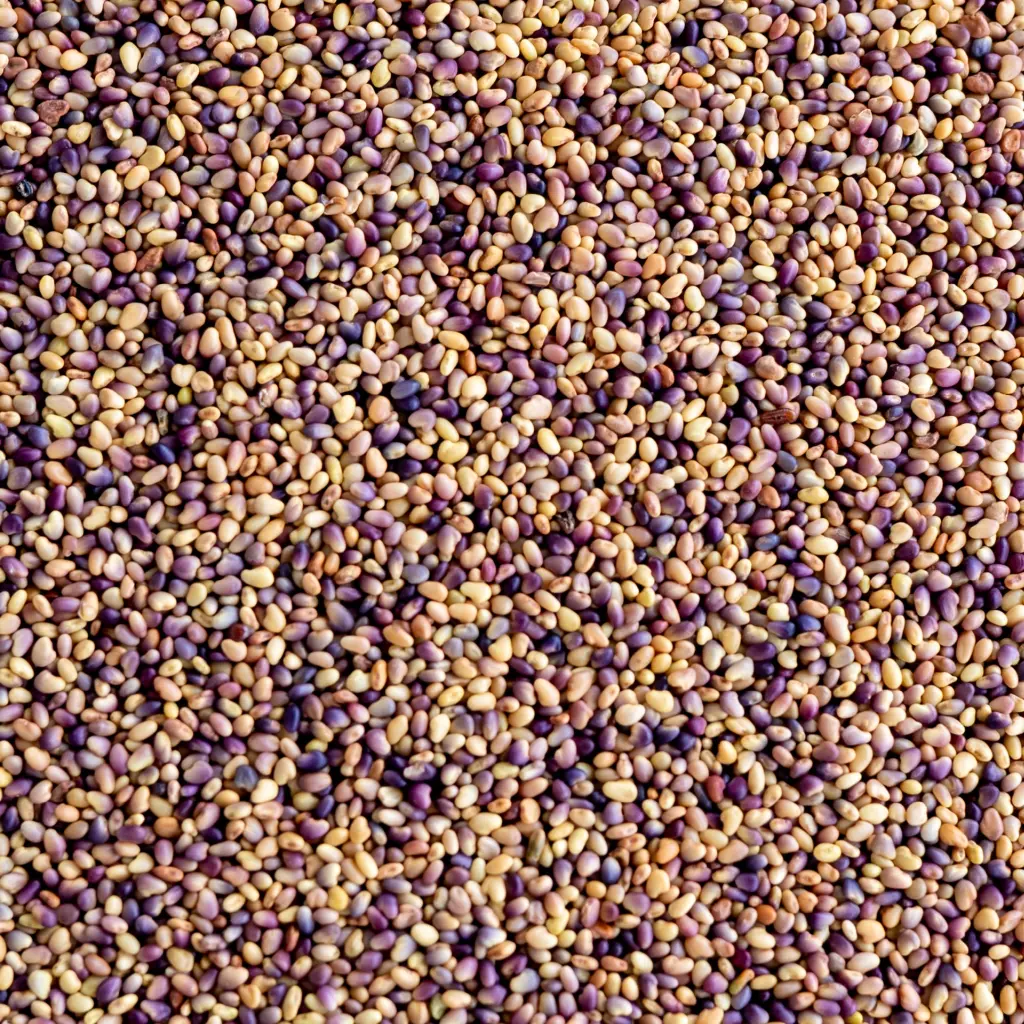
Red clover (Trifolium pratense) is a productive short-lived perennial legume with strong biomass production and nitrogen-fixing capacity. Its vigorous taproot and branching root system improve soil structure and contribute substantial organic matter below ground. It is particularly valuable in longer cover-crop periods, undersowing systems and rotations where nitrogen supply for the following crop is important. Red clover performs best on reasonably fertile, well-drained soils and generally produces more above-ground biomass than white clover.
From3,40 €
Nitrogen fixing partnership
Fixes atmospheric nitrogen with compatible rhizobia.
Deeper root exploration
Taproots explore deeper soil layers.
Longer lasting cover
Perennial growth for longer cover periods.
What is in the pack?
Seeds of Trifolium pratense. Available pack sizes: 1 kg, 100 g, 250 g, 500 g.
How and when should you use it?
Choose for longer cover periods or undersowing on well drained soil. Fit establishment and termination around the main crop. Use the seed lot guide to confirm sowing depth and seed rate. Nitrogen fixation requires compatible rhizobia.
Delivery and support
You receive the product in your selected pack size. Check the packaging and label on arrival, and follow its storage and use instructions. General background: https://biomenation.com/knowledge-base/
Red clover — Trifolium pratense
Type: Short-lived perennial legume
Main functions: Nitrogen fixation, biomass production, soil structuring, pollinator support
Typical sowing window: March–April or August–early September
Sowing depth: 0.5–2 cm
Approx. pure-stand seed rate: 10–18 kg/ha
Root system: Strong taproot with numerous lateral roots
Winter behaviour: Generally winter-hardy
Red clover combines substantial above-ground biomass with considerably deeper rooting than white clover. This makes it particularly valuable in rotations where a cover can remain for several months or longer and where biological nitrogen input is a major objective.
The taproot contributes to soil porosity while fine lateral roots increase rhizosphere activity and aggregate formation. Red clover is frequently undersown into cereals, allowing the cover crop to become established before harvest and develop rapidly once the cereal canopy is removed.
Adequate phosphorus, potassium, sulphur and appropriate rhizobial activity are important for effective nitrogen fixation. Avoid excessively deep sowing, particularly in heavy soils.
Why it works
Longer root activity. Legume potential.
01
Nitrogen fixing partnership
Deep taproots explore soil layers beyond those reached by shallower plants.
02
Deeper root exploration
Deep taproots explore soil layers beyond those reached by shallower plants.
03
Longer lasting cover
Perennial growth can maintain living roots in soil over longer periods.
Built for the whole system
INOQ A300 mycorrhiza concentrate
Red clover provides living roots and a legume contribution. INOQ A300 mycorrhiza concentrate can associate with compatible roots; it does not replace the rhizobia needed for nitrogen fixation.